Skip to content
Preparedness School

HomeNobody saw it comingThe Big One

Case study · San Andreas Fault

Prepare for the Big One

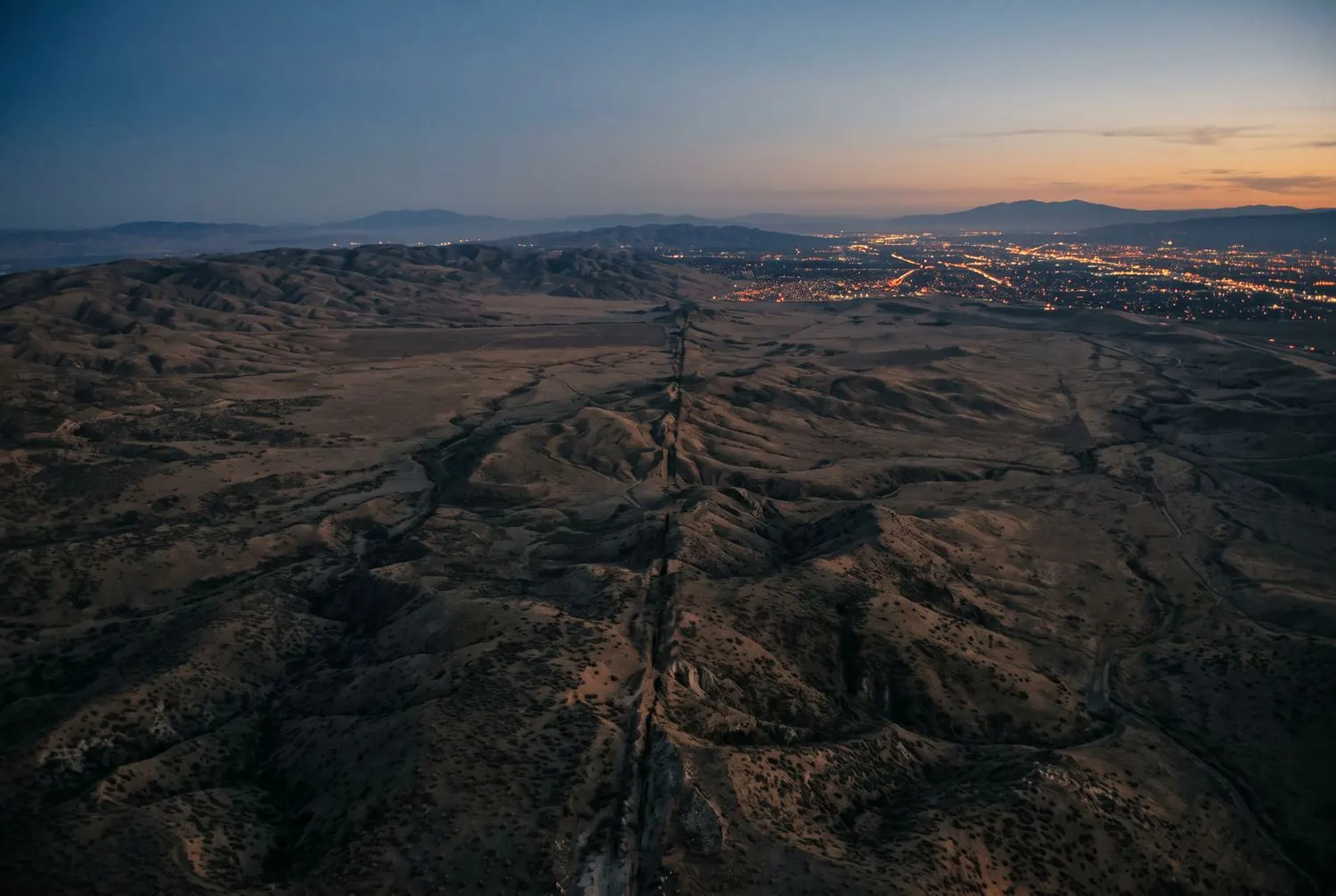
It is the great earthquake scientists expect on the San Andreas Fault, which runs about 1,300 km (800 mi) through California. Nobody knows when it will happen; what has been calculated is what a magnitude 7.8 on the southern part of the fault would do.

Aerial view of a fault crossing dry hills toward a city at night
Illustrative image
The fault

Three sections, two locked

San Andreas is the boundary between two plates sliding sideways past each other. Where the fault locks, it builds up stress for centuries and releases it all at once.

46 mma year (1.8 in) is how fast the Pacific Plate moves relative to the North American Plate
7.9was the magnitude of the last two great earthquakes: 1857 and 1906
300 yearssince the southern end of the fault last ruptured
8.3is the maximum magnitude estimated for the southern section

Northern section

  • From Hollister to Cape MendocinoIt runs past San Francisco and the Bay.
  • Ruptured in 1906Magnitude close to 7.9: 477 km (296 mi) of the fault moved and more than 3,000 people died, many in the fires.
  • The Bay today72% chance of a magnitude 6.7 or larger earthquake before 2043, counting its neighboring faults.

Central section

  • From Parkfield to HollisterThis is the section that "creeps": it slides slowly, with almost no shaking.
  • No great earthquakes on recordIt releases movement little by little, but it separates two sections that do lock.
  • Why it mattersA large rupture in the south tends to stop here, and so does one from the north.

Southern section

  • From Parkfield to the Salton SeaThis is the one that threatens Los Angeles and where the Big One is expected.
  • Ruptured in 1857The Fort Tejon earthquake, magnitude 7.9: it shook for one to three minutes. Two people died because there was hardly anyone living there.
  • The southern end has been quiet for about 300 yearsBetween Palm Springs and the Salton Sea it ruptures every 200 to 300 years. At Wrightwood, every 100 years on average.

Sources: Live Science: the San Andreas Fault · USGS: the San Andreas Fault's past · USGS: Will California fall into the ocean?

The official scenario · magnitude 7.8 on the southern sectionCalculated in 2008 by more than 300 scientists and engineers. The fault would slip up to 13 m (43 ft), and up to 8 m (26 ft) where highways, aqueducts and gas pipelines cross it.

7%chance of a magnitude 8 or larger earthquake in California in 30 years
1,800dead and 53,000 injured in the official magnitude 7.8 scenario
1,600fires after the earthquake: they cause almost half the losses
191,000million dollars ($191 billion) in estimated total losses

How cities prepare

  • Alerts on your phoneShakeAlert warns from a few seconds to half a minute before the shaking. More than 4.5 million Californians have the MyShake app.
  • Mandatory retrofits in Los AngelesMore than 12,000 buildings with open ground floors: as of January 2024, 75% had already been retrofitted. The nearly 1,200 older concrete buildings have until 2041.
  • San Francisco reviews its towersIt has 156 buildings taller than 73 m (240 ft). A 2018 study called for reinspecting about 70 with welded steel frames.
  • A drill every OctoberThe Great ShakeOut is held every year; in 2026 it was on October 15, with a test alert on phones.

How you can prepare

  • Practice "drop, cover and hold on"The shaking from a large earthquake can last minutes. Don't run outside.
  • Supplies for two weeks, not three daysThe scenario expects long water outages: those alone would cost 24 billion dollars.
  • Prevent firesSecure your water heater with metal straps and learn to shut off the gas valve.
  • Turn on earthquake alertsAndroid has included them since 2020; in California, Oregon and Washington they also come through MyShake.

Full guide: what to do in an earthquakeSources: USGS, ShakeOut scenario · USGS, UCERF3 forecast · KQED, October 2026 · NBC, January 2024 · Claims Journal, San Francisco towers study · Oregon State University

What people ask

Likely, but with no date

California's official forecast gives 30-year probabilities. It doesn't say when, and nobody can.

7%chance of a magnitude 8 or larger earthquake in California in 30 years
60%chance of a magnitude 6.7 or larger in the Los Angeles region before 2043
72%chance of a magnitude 6.7 or larger in the San Francisco Bay Area before 2043
6.3 yearspass on average between two magnitude 6.7 or larger earthquakes in California
Can we know when it will happen?No. Nobody has ever predicted a large earthquake with a date, place and magnitude. What exists are 30-year probabilities.
Does "overdue" mean imminent?No. The averages come from ancient earthquakes dated in trenches; the authors themselves warn they can't tell when the next one will be.
Will California sink into the sea?No. The two plates slide sideways, about 46 mm (1.8 in) a year. Over time, Los Angeles and San Francisco will end up next to each other.
Can there be a magnitude 10 earthquake?No fault that long is known. The largest ever recorded was a 9.5 in Chile, in 1960. For the southern San Andreas, the estimated maximum is close to 8.3.
Do small earthquakes relieve the fault?Very little. It takes about 32 magnitude 5 earthquakes to release the energy of one magnitude 6, and about a thousand magnitude 4s.
Is there such a thing as "earthquake weather"?No. Earthquakes start kilometers underground and happen in any weather and at any time of day.
Sources: USGS, UCERF3 forecast · USGS: Can earthquakes be predicted? · USGS: Will California fall into the ocean? · USGS: Can there be a magnitude 10 earthquake? · USGS: Earthquake facts and fantasy · Live Science: the San Andreas Fault

It's not just California

The Big One in other countries

Many coastlines live next to a fault that is building up stress. These are six of the most studied.

US and Canada · Cascadia37%chance of a magnitude 7.1 or larger in 50 years

The last one was a magnitude 9 on January 26, 1700. Five to seven minutes of shaking and two weeks without help are expected.

Oregon Office of Emergency Management
Turkey · Istanbul62%chance of strong shaking in 30 years

An estimate published in 2000, with a 15-point margin, after the 1999 Izmit earthquake. The fault runs under the Sea of Marmara, right off the city.

USGS, Parsons et al.
Chile · Valdivia9.5the largest earthquake ever recorded

It happened on May 22, 1960 on a fault almost 1,600 km (1,000 mi) long. Countries on the Pacific coast already know what a Big One is.

USGS
How to prepare

What you do before is what counts

A large earthquake doesn't give hours of warning. Where you live and what you have sorted out that day is what you will have to rely on.

Where to live

  • If you can choose, a low house rather than a tall buildingWood-frame houses are light and flexible: they withstand shaking that brings down brick walls.
  • The house must be anchored to its foundationBolting it down and bracing the cripple wall under the floor is what protects a wood-frame house the most.
  • High up, you depend on everythingEven if the building holds, without elevators or water pumps the stairs are the only way up and down.
  • Careful: not every house is saferAn adobe or unreinforced brick house is more dangerous than a well-built building. If you live in a building, find out what year it was built and whether it was retrofitted.

Everything this site has for a big earthquake

What if it happened where you live?